
Why Are 24 States and D.C. Refusing To Produce Voter Rolls?
They say they are withholding their voter rolls from the U.S. Dept. of Justice to protect voter privacy, but are they also protecting voter fraud and illegal immigrants?
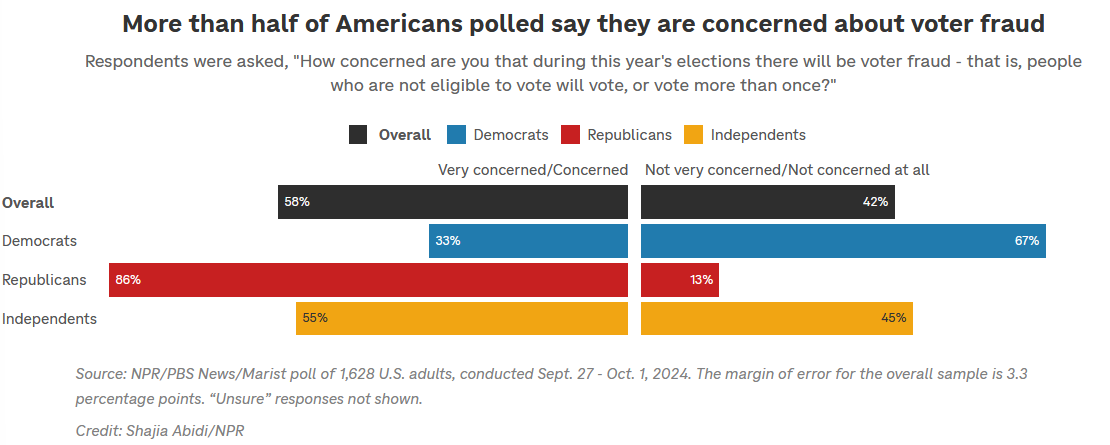
A national 2024 poll found that 58% of American adults — almost six in 10 — worried the 2024 election would be tainted by voter fraud.
Of those voters, nearly 90% of likely Trump voters expressed concern about voter fraud. Donald Trump received about seventy-seven million votes.
Without getting into arguments about the extent of voter fraud, it is clear that voter fraud is a concern for a significant portion of American voters. What is a sensible response to a concern of this magnitude?
The Trump administration’s Department of Justice (DOJ) has filed lawsuits against 24 states and the District of Columbia that have refused to release their full, unredacted voter rolls. Attorney General Pamela Bondi says the DOJ wants to protect the integrity of American elections.
“Accurate voter rolls are the foundation of election integrity, and any state that fails to meet this basic obligation of transparency can expect to see us in court,” said Bondi.
State voter rolls are generally public, and routinely distributed to political parties seeking to get out the vote. There is no inherent right to privacy for voter registration — only with respect to how the registrant voted.
The point in dispute is that the DOJ is seeking full and unredacted voter rolls that include partial social security numbers, driver’s license numbers, dates of birth, etc. The Department of Homeland Security has stated that it would receive the data from the DOJ to “scrub aliens from voter rolls.”
Setback
Last week, two federal judges in California and Oregon, both nominated by Democratic presidents, issued decisions that constitute a major setback for the DOJ.
U.S. District Judge David O. Carter of San Diego, CA, who was nominated by former Democratic President Bill Clinton, called the DOJ’s request for unredacted voter files “unprecedented and illegal.” He dismissed the case.
Carter wrote that “the centralization of this information by the federal government would have a chilling effect on voter registration which would inevitably lead to decreasing voter turnout as voters fear that their information is being used for some inappropriate or unlawful purpose.”
U.S. District Judge Mustafa T. Kasubhai of Portland, Oregon, a nominee of former Democratic President Joe Biden, tentatively dismissed the Oregon case in a ruling from the bench. He cited privacy limits on federal authority for unredacted access to state voter files, and prioritized voter privacy over broad demands. He is expected to issue a written ruling.
The DOJ argues that the U.S. Attorney General is charged by Congress with the enforcement of the National Voter Registration Act (NVRA) and the Help America Vote Act (HAVA), which were designed to ensure that states have proper and effective voter registration and voter list maintenance programs. DOJ officials also say the Civil Rights Act of 1980 (CRA) permits DOJ to demand the production, inspection, and analysis of the statewide voter registration lists.
“Accurate voter rolls are essential to ensuring that American citizens’ votes count only once, and only with other eligible voters,” said Assistant Attorney General Harmeet K. Dhillon of the DOJ’s Civil Rights Division. “The Justice Department is committed to safeguarding fair and free elections, and will hold states accountable when they refuse to respect our federal election laws,” she said.
DOJ official say states are attempting to hide information that they are required to disclose, further undermining public trust in elections. They say the lawsuits are meant to deter non-citizen voting and voter fraud.
In his decision, Carter wrote that the civil rights laws cited by the DOJ to justify its demand for the records were “to protect hard won civil rights victories allowing access to the ballot box,” not to give the executive branch or president unfettered access to voter data.
Carter wrote the government’s request is “unprecedented” and seeks information such as names, social security numbers, home addresses, voting history and “other sensitive information” for nearly 23 million Californians. He said only Congress can “authorize the use of civil rights legislation as a tool to forsake the privacy rights of millions of Americans.”
Mostly Democratic States
All but two of the 24 states and the District of Columbia that have refused to turn over full, unredacted voting rolls have Democratic state attorneys general. They are Republican-controlled Georgia, which has been a focal point for GOP accusations of voter fraud, and Nevada, which was sued by Republicans in 2024 for allegedly permitting voting by illegal immigrants.
The other states (and the District of Columbia) are generally controlled by Democrats and include:
Arizona
California
Colorado
Connecticut
Delaware
Hawaii
Illinois
Maine
Maryland
Massachusetts
Michigan
Minnesota
New Hampshire
New Mexico
New York
Oregon
Pennsylvania
Rhode Island
Vermont
Virginia
Washington
Wisconsin
The California case is United States v. Weber (U.S. District Court, Central District of California, Case No. 8:25-cv-01562-DOC-ADS).