
Washington Fiddles While Employers Replace Workers With AI and Robots
Artificial Intelligence promises positive changes in the years ahead, but it also is expected to result in the loss of millions of jobs in the near future. Why isn't Washington acting?
The notice in my mailbox this week from a local warehouse for a national retail distributor advertised jobs that pay $25 an hour, plus $5 a week health insurance.
That’s great, but how long before those jobs disappear?
It’s only a question of time before warehouses are run by a few workers behind a computer screen using Artificial Intelligence (AI), and the actual work is done by robots.
Thousands of local workers who now earn a decent wage and have access to cheap health insurance, will be laid off. It’s not like they can go to another warehouse, which also will be run by AI and staffed by robots.
AFL-CIO President Liz Shuler, whose federation of 65 unions represents 15 million workers, said Tuesday that AI poses the “single biggest threat to working people of our lifetime.” She said no worker will be untouched and that “every job is now a technology job.”
White Collar
It’s not just the jobs of warehouse workers that are vulnerable.
A recent Goldman Sachs report found that AI could potentially automate tasks that now account for 25% of all work hours and that it could displace about seven percent of U.S. workers within ten years.
Tech entrepreneur Dario Amodei, the CEO of Anthropic, told the Financial Times recently that “AI could eliminate about 50% of all entry-level white-collar jobs within five years, causing unemployment to surge… We should not deny that the disruption is going to happen.”
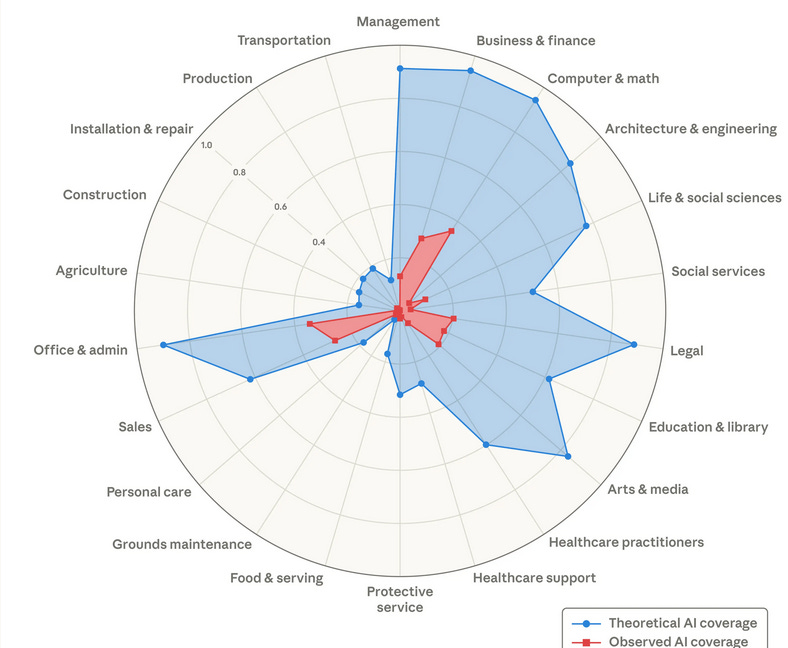
On Tuesday, Anthropic, which calls itself a public benefit corporation, released a report showing that the workers at risk for displacement include lawyers, financial analysts, market researchers and software developers. The report states that workers in the most “exposed professions” are more likely to be older, female, highly educated, and to earn 47% more than average.
Anthropic estimates that AI can handle 94% of computer and math worker tasks. It is currently handling 33%.
Anthropic reports that computer programmers have the “highest observed AI exposure,” which means they are most vulnerable to job loss from AI, followed by customer service representatives, data entry keyers, medical record specialists, market research analysts and marketing specialists.
The job situation is not all bad news.
Anthropic says 30% of workers are not threatened by job loss caused by AI, including cooks, mechanics, bartenders and dishwashers.
Congress Yawns
Despite the warnings, there is little urgency in Washington to meet the challenges ahead.
