
The Pentagon Calls 'Checkmate' On The Judicial Branch
A federal judge told the Pentagon it must allow legacy media journalists back into the Pentagon's press room, so the Pentagon moved its press room out of the Pentagon's main building. Now what?
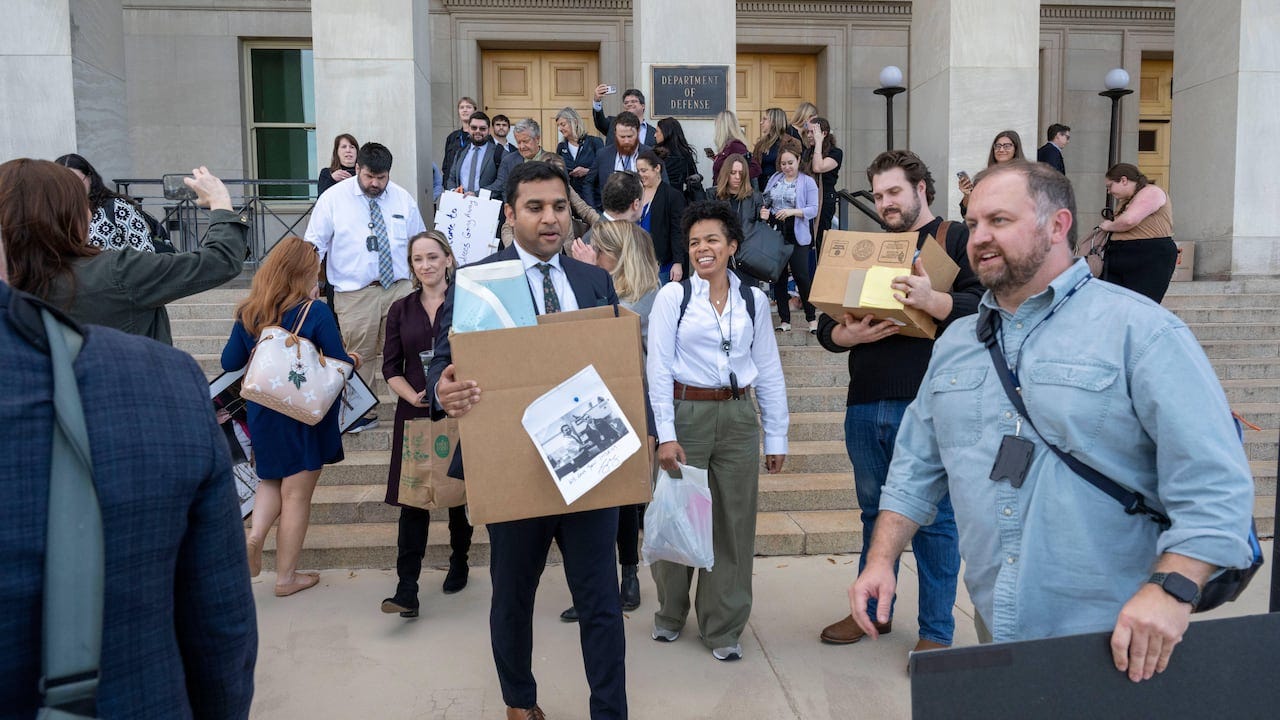
U.S. District Judge Paul Friedman of Washington D.C., a semi-retired appointee of former Democratic President Bill Clinton, ruled on April 9, 2026, the Department of War’s new press policy violated his earlier order. Friedman blocked the prohibition against reporters roaming unescorted in the Pentagon, and the relocation of the press room to an annex.
Did it ever make sense for journalists from around the world — who lack security clearances — to be wandering around the Pentagon, which is the headquarters of the U.S. Department of Defense, the nerve center for U.S. military planning, strategy, and operations?
I suspect that most Americans would agree that it did not.
After the second Trump administration took office last year, the Defense Department, which it infamously renamed Department of War (DoW), adopted new rules for the Pentagon press corps.
The DoW restricted unescorted movement inside the Pentagon.
But the DoW didn’t stop there. It also announced a new policy that discouraged journalists from asking Pentagon staff to violate laws and policies by disclosing non-public information, including classified material. Members of the Pentagon press corps were told they must sign an acknowledgement of the policy or lose their permanent press credentials and workspaces.
“The ‘press’ does not run the Pentagon — the people do. The press is no longer allowed to roam the halls of a secure facility. Wear a badge and follow the rules — or go home,” said DoW Secretary Pete Hegseth.
The New York Times filed a lawsuit that on Monday seemed to have devolved into a test of power between the executive and judicial branches of government.
New Media Interlopers
More than two dozen journalists from legacy media outlets refused to sign the new restrictive policy last fall, and lost their Pentagon credentials.
Meanwhile, Pentagon spokesperson Sean Parnell announced on social media that “over 60 journalists, representing a broad spectrum of new media outlets and independent journalists, have signed the Pentagon’s media access policy and will be joining the new Pentagon Press Corps.” The newcomers include The Gateway Pundit, Tim Pool’s “Timcast”, LindellTV (founded by My Pillow CEO and election denier Mike Lindell), and Turning Point USA’s Frontlines.
The worst insult to the legacy media may have been the Pentagon’s decision to credential conservative activist and Trump loyalist Laura Loomer, who was given a desk that previously belonged to a Washington Post reporter.

Parnell rubbed salt in the wound, stating, “Americans have largely abandoned digesting their news through the lens of activists who masquerade as journalists in the mainstream media.”
U.S. Sen. Tina Smith, D-Minnesota, immediately labeled the new contingent “The Pentagon Propaganda Corps.” Others called the new media representatives “far right sycophants,” “illegit,” and “conspiracy theorists.”
Ruling
The New York Times filed a lawsuit that resulted in a ruling by U.S. District Judge Paul Friedman of Washington, D.C, a semi-retired appointee of former Democratic President Bill Clinton.
On March 20, Friedman vacated the part of the Pentagon policy relating to credential revocation based on newsgathering activities. He said the policy violated journalists’ constitutional rights to free speech and due process. He ordered the Pentagon to immediately reinstate the press credentials of New York Times reporters.
Judge Friedman described the Pentagon policy as so vague that it makes “any newsgathering and reporting not blessed by the Department a potential basis for the denial, suspension, or revocation of a journalist’s [credential].” He said that even soliciting classified information can constitute legitimate newsgathering.
Friedman said the Pentagon policy also constituted viewpoint discrimination under the First Amendment because its intent was to replace “disfavored journalists” with “new entities” that are “willing to serve” the Pentagon.
Here’s the problem
Friedman works for the federal judiciary, which is governed by the Judicial Conference of the United States. The press is excluded from Conference meetings— which are secret— and the Conference rarely holds a press conference. It typically issues after-the-fact press releases announcing rule changes.
Moreover, the chair of the Conference is U.S. Supreme Court Chief Justice John G. Roberts, Jr., who works at the Supreme Court, where judicial chambers are off-limits to reporters without an explicit invitation or escort.
Who is Judge Friedman to tell the executive branch that it must comply with security policies the judicial branch itself does not follow for its own operations?
The Pentagon says it will appeal.
Checkmate?
On Monday, the New York Times returned to court, claiming the Pentagon was flouting Friedman’s order with a new “interim policy” that removes the Pentagon press workspace to an annex facility outside the Pentagon that can only be reached via shuttle bus or a corridor with restricted access.
The Times accused the Pentagon of defying Friedman’s order “in letter and spirit.”
The new interim policy appears to have the effect of the original policy. It prevents reporters from wandering the halls of the Pentagon to solicit information that has not been publicly disclosed — including classified material — from DoW staffers. Does the U.S. Constitution prohibit the Pentagon from establishing a press workplace in an outside annex when Friedman’s boss, the Judicial Conference, doesn’t even have a press workplace.
Why can’t the Pentagon simply stop providing any access to the press, like the Judicial Conference?
Judge Friedman did not rule from the bench.
Data from the Pew Research Center shows that 86% of U.S. adults now get their news from digital devises, including smartphones, social media and websites. Top sources include Facebook, YouTube, news apps, search engines and podcasts. Of course, legacy media outlets now maintain a digital presence.