
The Left's War On Child Safety
Protecting children on the Internet should be a given, but every time there is a proposed solution, the left goes on the offensive. The new target is the GUARD Act.
Whenever an effort is made to protect children on the internet, there is an immediate outcry from a phalanx of left groups.
This time the Electronic Frontier Foundation (EFF), which advocates for privacy and anonymity on the internet, is leading the charge against the proposed GUARD Act, which was approved recently by the U.S. Senate Judiciary Committee. GUARD is an acronym for Guidelines for User Age-verification and Responsible Dialogue Act of 2025.
The bipartisan bill would require AI chatbots to implement age verification measures, and impose criminal penalties on companies whose AI chatbots engage in sexually explicit conduct with minors, or solicit minors to commit self-harm or violence. The bill was introduced by U.S. Sen. Josh Hawley (R-MO), who calls it the “stop telling kids to kill themselves” bill.
According to the GUARD Act: “Protecting children from artificial intelligence chatbots that simulate human interaction without accountability is a compelling government interest.”
The EFF this week warned about a parade of horribles. Among other things, the EFF claims the act will “force ID checks for everyone using AI tools and block teens from everyday internet use. Tell your reps to oppose it today.”
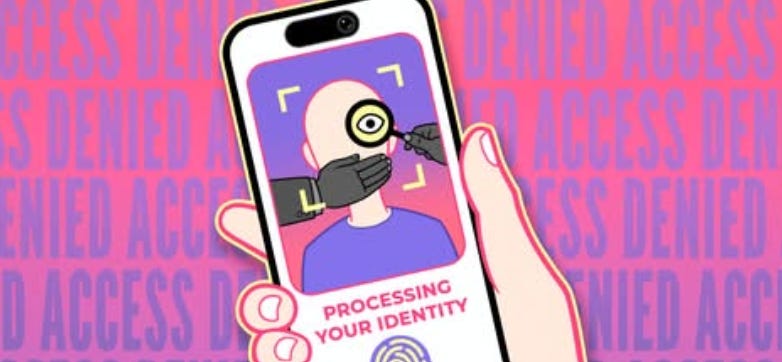
The EFF published a graphic depicting what appears to be an African American silencing a white man, who is being subjected to invasive personal scrutiny.
Litigation
The battle to protect children online is being increasingly compared to the decades-long battle to stop the marketing of cancer-causing cigarettes.
The EFF, which is based in San Francisco, has argued that age verification mandates are not the right approach to protecting young people online, though it does not appear to offer a better alternative.
U.S. Surgeon General Dr. Vivek Murthy in 2023 issued a landmark advisory opinion that social media poses a “profound risk of harm” to youth.
Meanwhile, thousands of lawsuits have been filed against social media platforms, including two that recently scored important victories.
A New Mexico jury on March 24 slammed Meta, which owns Instagram and Facebook, with a $375 million verdict for intentionally violating state consumer protection laws by misleading the public about platform safety for children, enabling the sexual exploitation of young users. The verdict marked the first time a jury ruled on such claims.
New Mexico Attorney General Raúl Torrez, a Democrat, called the verdict "a historic victory for every child and family who has paid the price for Meta’s choice to put profits over kids’ safety."
A day later a Los Angeles jury returned a $6 million verdict in favor of a minor plaintiff against Meta and Google’s YouTube for deploying an addictive product design - the infinite scroll - that caused a decline in the child’s mental health. The plaintiff, now 20, claimed she suffered body dysmorphia and depression because the platform hooked her through features like infinite scrolling, autoplaying videos, and beauty filters.
The U.S. Congress lags far behind other countries in protecting children and youth from online harms.
