
The Law Is The Law - Unless It Involves Age Discrimination
The FBI is settling a Privacy Act lawsuit filed by notorious former FBI agents Peter Strzok and Lisa Page because 'the law is the law.' But the law is an illusion when it comes to age discrimination.
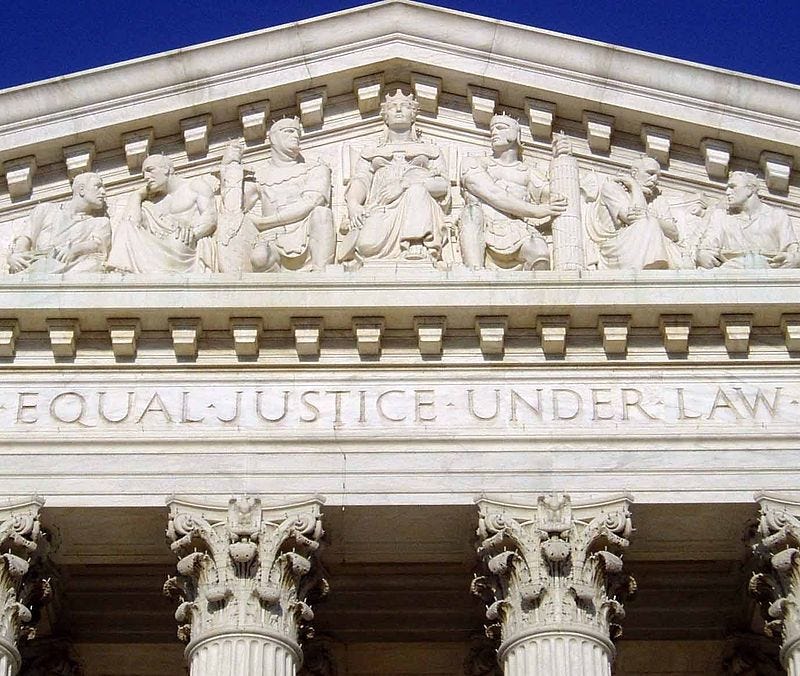
The U.S. Supreme Court liberally interpreted a provision of the Age Discrimination in Employment Act of 1967 (ADEA) in a landmark 2020 decision, Babb v Willkie, 140 S. Ct. 1168 (2020).
This decision is the law. Except that it isn’t. Federal courts completely ignore it.
Meanwhile, the average age of federal judges was 69 in 2020, the last year for which statistics are available. This was higher than it has ever been in the country’s history. These same judges ignore the ADEA and are hostile to older plaintiffs. They never feel the consequences of their decisions because they never have to retire.
As some of you know, I filed an EEOC complaint in 2011 - the lingering aftermath of the great recession - when the Social Security Administration (SSA) hired five new attorneys based on a recruitment that was limited to two institutions with populations well under the age of 40, the University of Nevada law school and an office of outgoing Peace Corps volunteers.
Twenty-six of the 27 applicants were under the age of 40, while a single male outgoing Peace Corps volunteer was 47.
My EEOC complaint became a lawsuit in 2017. The presiding judge, Miranda M. Du, immediately dismissed the case with prejudice - meaning I couldn’t file it again - on the grounds of futility.
The lawsuit was reinstated by a panel of the U.S. Court of Appeals for the Ninth Circuit in San Francisco, which held it was “common sense” that a recruitment limited to two institutions with populations under age 40 discriminated based on age.
Du, now the chief judge for the state of Nevada, dismissed the lawsuit again, this time inventing “critical” facts that the recruitment was broader than it seemed. Among other things, she said that students and alumni from other law schools saw the job vacancies on the Nevada law school’s electronic job board.
The SSA never claimed a single “reciprocity holder” saw the vacancy notice on Nevada law school’s electronic job board. The SSA literally admitted (and the hiring officer testified) that it had no idea how or even whether the law school disseminated the vacancy notices. There was no evidence the vacancies were even posted on the Nevada law school electronic job board.
I appealed to the Ninth Circuit a second time and the case was assigned to a Pasadena, CA, panel that included two Trump appointees, Ryan D. Nelson and Lawrence Vandyke, and a recent Biden appointee, Gabriel P. Sanchez. The panel cancelled a hearing at the last minute - after scheduling it - and dismissed the case in a four-page opinion, of which only a couple of lines addressed its reasoning.
Were they protecting a coworker? Were they were engaging in age discrimination themselves?
Outrageously, the panel adopted Judge Du’s “invented” facts and, like Du, entirely ignored U.S. Supreme Court and Ninth Circuit precedent.
High Court?
So here’s what the U.S. Supreme Court said about the federal sector clause of the ADEA in the Babb case:
“All personnel actions affecting employees or applicants for employment who are at least 40 years of age . . . shall be made free from any discrimination based on age.”
In addition to the recruitment, there was a huge volume of circumstantial evidence. For example, the SSA ignored my contemporaneous complaint the recruitment discriminated against older workers and proceeded to hire recent law school graduates. The hiring office testified he did not consider experience or qualifications. There was even direct evidence - a note by the hiring officer extolling the youth of a younger applicant.
The ADEA says if there is ANY evidence of age discrimination in hiring, a federal agency has violated the ADEA.
It literally couldn’t be any clearer. Age cannot be a factor in hiring by the federal government. Period. This was the 8-1 majority opinion of the U.S. Supreme Court.
If Congress had a problem with the high court’s decision, it could easily have acted to amend the ADEA or pass a new law. It has not done so.
Why don’t federal judges have to follow the law?
Attorney General Merrick Garland
Attorney General Merrick Garland Monday during testimony before the House Judiciary Committee defended the U.S. Department of Justice’s decision to pay a settlement amount - not yet disclosed - to former FBI agents Peter Strzok and Lisa Page. Garland said the DOJ has no choice because the “law is the law.”
Strzok and Page, who were engaged in an extramarital affair, were actively involved in an effort to thwart the presidency of Donald J. Trump in 2016. Strzok, a 21-year veteran of the FBI, sent a text to Page saying, “F Trump” and “I can protect our country at so many levels.” He said “God Hillary should win 100,000,000-0.”

The damage done by the pair to the reputation of the FBI is incalculable.
Strzok played a pivotal role in the FBI’s less than vigorous investigation of Clinton’s use of a private email server while serving as Secretary of State and her subsequent destruction of thousands of emails from the private server. Strzok worked in the FBI’s bogus probe of Trump’s supposed Russia ties, which he characterized as an “insurance policy” that would sink Trump.
If the law is the law for Strzok, why isn’t it the law for victims of age discrimination ?
The U.S. Court of Appeals for the Ninth Circuit declined to intervene in the panel’s decision of dismissal of my appeal, without comment. Thus, the Ninth Circuit gave judges Du, Nelson, Vandyke and Sanchez legal cover to thumb their nose at the U.S. Supreme Court and older workers. The Ninth Circuit sanctioned age discrimination in violation of the ADEA. The Ninth Circuit ultimately said that the law is not the law. It’s a suggestion.