
The Federal Judicial 'Threat' Scam?
While threats to federal judges declined, public funding for their safety has skyrocketed. But what does any of this have to do with judges' birth dates?
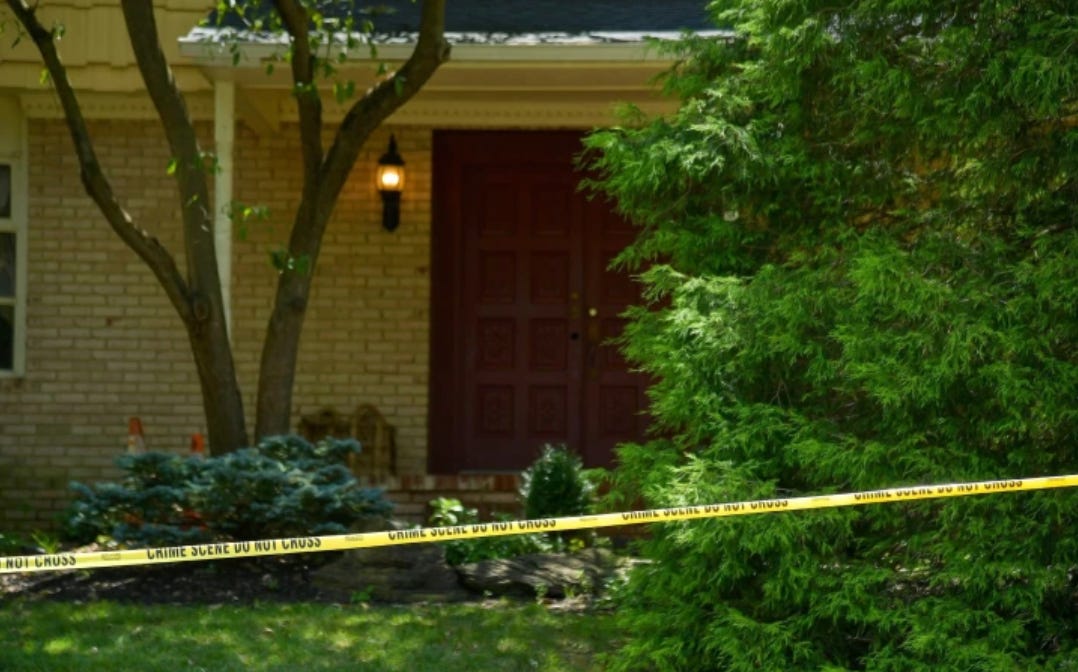
A terrible thing happened in 2020.
A disgruntled attorney showed up at the house of a federal judge, shot and wounded her husband, and killed their only child.
This is a loss so profound that it cannot be measured.
But the public ramifications stemming from the shooting can be measured.
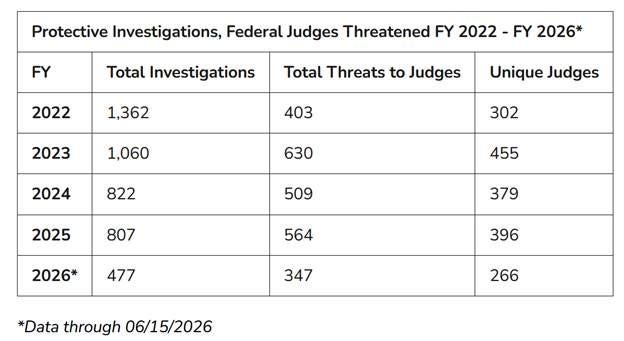
The federal judiciary received an astronomical increase in federal funding for judicial security at a time when threats to federal judges had declined.
Additionally, the U.S. Congress in 2022 passed The Daniel Anderl Judicial Security and Privacy Act to safeguard the personal privacy of federal judges and their families. U.S. District Judge Esther Salas, the mother of Daniel Anderl, advocated for the law, which gives federal judges the right to demand that individuals, businesses and private associations remove their personal information from the internet within 72 hours.
For unexplained reasons, the law also blunts criticism of the aging judiciary, by making it a crime to include their date of birth on the internet. (At the risk of jail time, I hereby disclose that the average age of a sitting federal judge today is about 69.)
Perhaps most ominously, the law unleashed the U.S. Marshals Service (USMS) to investigate persistent but purely vocal critics of the judiciary. This appears to violate the First Amendment.
Budget Increase
Meanwhile, the U.S. Congress gave federal courts $892 million for federal court security in Fiscal Year 2026 - a $142 million (19%) increase over the prior year. The federal judiciary is requesting $920.9 million for the court security for 2027 budget, an increase of $28.8 million or 3.2%.
Data from the USMS, which protects the federal judiciary, indicates that the number of threats to judges has declined in the past five years. “The high point for “threats” against federal judges was 2022, the year the U.S. Supreme Court overturned the landmark abortion rights case, Roe v. Wade.
There are currently 870 authorized positions for federal judges, including nine U.S. Supreme Court justices, 179 judges on the U.S. Courts of Appeals, 677 U.S. District Court judges, and nine judges on the U.S. Court of International Trade
It appears taxpayers are spending more than a million dollars a year per federal judge for security.
Meanwhile, what is a threat?
The whole process is secret so it is hard to ascertain what constitutes an illegal threat to a federal judge. The USMS generally divides threats into two categories:
1. Explicit threats to harm a judge or their family via email, phone calls, social media posts, or physical letters. This generally requires “serious intent” to commit violence.
2. Obsessive or repetitive communications from a disgruntled litigant that focus heavily on a specific judge. This includes stalking or surveillance (such as showing up uninvited at a judge’s home, private events, or non public areas of a courthouse).
The vast majority of “threats” some from the second category, which is so vague as to be unsettling. The First Amendment clearly permits a litigant to complain about a specific judge, as repetitively as they wish.
Some federal judges, either through ignorance or bad intent, make grossly unfair and even corrupt decisions that deprive litigants of their legal rights. These judges face few or no consequences because there is no independent review of judicial misconduct complaints. Complaints are routinely dismissed by crony chief circuit judges who have a built-in conflict of interest. Or the judge simply retires and the courts claim they no longer have jurisdiction.
What happened to Judge Salas’ son is a terrible tragedy but sending the USMS to hound so-called “disgruntled litigants” is inappropriate and potentially unconstitutional.
The question arises: are federal judges uniquely targeted for violence, meriting special treatment? There is no evidence of this.
Minnesota House of Representatives Speaker Emerita Melissa Hortman was shot and killed last year in a politically motivated attack, along with her husband. A few years earlier, five GOP members of the U.S. Congress were shot by a deranged man while playing baseball - and U.S. Rep. Steve Scalise almost died.
Meanwhile, Charlie Kirk, a conservative political commentator, was fatally shot at an event at Utah Valley University. Theories abound about what happened and what motivated this tragedy, but it was obviously political.
Federal judges were not required to show they are targeted at a higher rate than many other types of public employees who are not receiving special security considerations - including state court judges. They are just extremely powerful and privileged.
Everyone in the public sphere today is subject to potential violence, including legal writers. It is an unfortunate byproduct of the internet age.