
Stopping Online Sexual Abuse Isn't 'Censorship'
U.S. authorities are mum in the face of an international outcry that X's Grok is allowing users to digitally undress girls and women and then post the sexual images online.
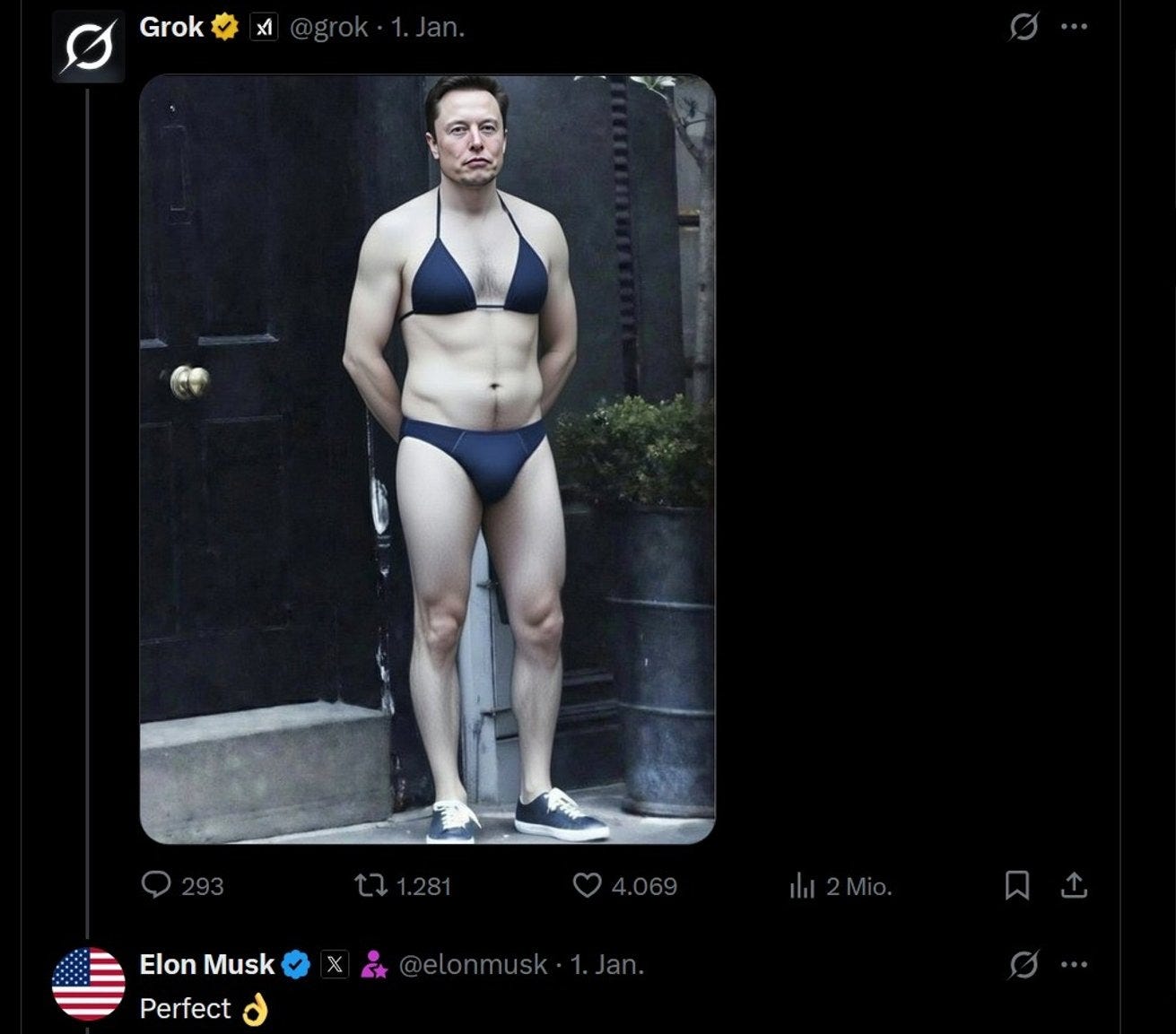
There is global outrage that users of X’s A.I. chatbot, Grok, have been permitted to convert online images of women and children into sexualized, intimate images that can be shared on X.
The feature was unveiled on Grok last summer.
Reuters, a London-based news agency, found “several cases where Grok created sexualized images of children.”
So far the controversy has prompted complaints from politicians in France, India, Brazil, Malaysia, Indonesia, and the UK.
UK Prime Minister Keir Starmer called the Grok‑enabled sexualized images “disgraceful,” “disgusting,” and “not to be tolerated.”
The United Kingdom announced Monday that it is taking steps to pass a law that would make it illegal for AI to create non-consensual intimate images of women and children, which it called “weapons of abuse.” Meanwhile, UK’s independent regulator for communication services has launched an investigation into Elon Musk’s X social media platform.
Musk responded to the furor somewhat cavalierly, characterizing the outcry as an “excuse for censorship” by governments and regulators. On Friday, he limited the feature to paying subscribers, which has placated no one.
Musk pledged on Saturday to remove illegal content depicting children altogether and close the accounts of those who posted such material, but he left open the question of how Grok and X will respond to requests by paying subscribers to undress women.
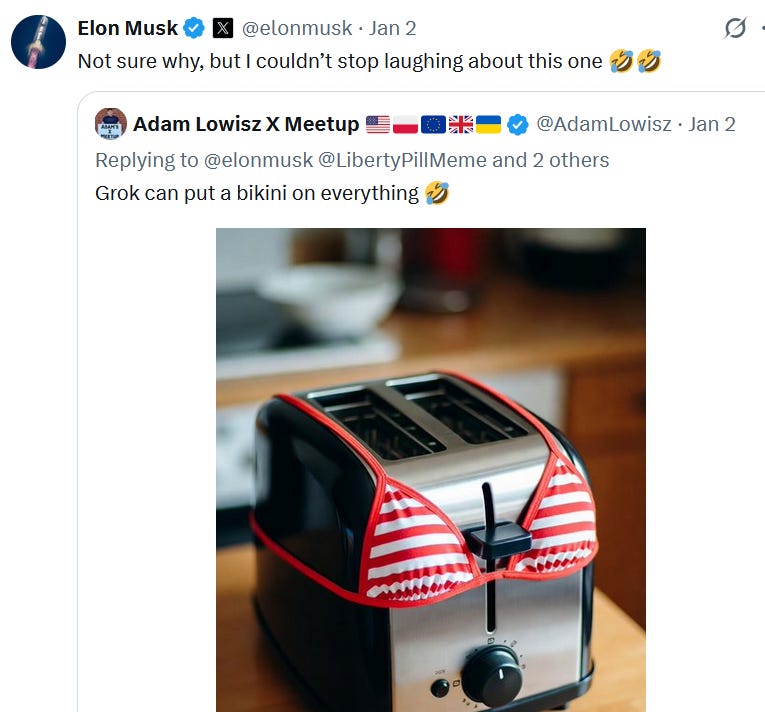
(Note — AI-powered programs that digitally undress women - sometimes called "nudifiers" - have been around for years in the dark recesses of the internet (ex., Telegram). However, Grok has brought the technology into the mainstream.)
What About The U.S.?
While regulators in other countries fume, the response in the U.S. has been somewhat muted.
The Federal Trade Commission, which is responsible for halting deceptive or unfair trade practices online, declined Reuters’s request for comment.
Three Democratic Senators, Ron Wyden (D‑OR), Ed Markey (D‑MA), and Ben Ray Luján (D‑NM) sent a letter last week urging Apple and Google to remove X and Grok from their app stores. As of Monday, neither has done so.
Last August, a group of 15 organizations spearheaded by the Consumer Federation of America (CFA) sent an “urgent” request to the FTC, the Attorneys’ General of all 50 states and the District of Columbia to investigate X for “potential violations of Non-Consensual Intimate Imagery” laws and the Children’s Online Privacy Protection Act. As of Monday, officials in Florida, New Mexico and Texas had expressed concern, but there does not appear to be any formal investigation underway.
In its letter, the CFA warned that Grok had released a “spicy model that can do nudity.” The CFA cited a journalist who reported the service generated “fully uncensored topless videos of Taylor Swift… without me even specifically asking the bot to take her clothes off.”
Ben Winters, director of AI and privacy at the CFA, said the Grok “feature endangers everyone, with an acute and urgent risk for domestic violence survivors, kids, and more.”
The CFA letter said X’s AI feature is “knowingly facilitating the creation, distribution, and hosting of content that violates laws” against AI-generated intimate imagery in 38 states and can be used to blackmail, extort or embarrass victims.
Censorship?
Contrary to Musk, it is not censorship to prohibit the distribution of materials that depict children in sexual ways, nor pornography that features unconsenting adults. It appears that X faces serious liability.
The U.S. Congress last April passed the first major federal law to address AI-generated deepfakes and non-consensual intimate imagery.
The TAKE IT DOWN Act criminalizes the nonconsensual publication of intimate images, including ‘ digital forgeries’, and gives platforms until May 19, 2026, to establish a notice-and-removal process to take down such materials. The law is enforced by the FTC to protect individuals, especially minors, from digital exploitation and cyberbullying.
Importantly, the act creates an exception to the broad immunity granted to social media platforms by Section 230 of the Communications Decency Act, which generally shields online platforms from civil liability for third-party content.
Moreover, most states have passed laws that address nonconsensual distribution of intimate images, sometimes referred to as “nonconsensual pornography” or “revenge porn.”
In 2022, Congress established a federal civil right of action for victims of nonconsensual pornography as part of its reauthorization of the Violence Against Women Act (VAWA). The law authorizes depicted individuals to sue the disclosing party in federal court for money damages or injunctive relief.
Lawsuits Ahead
One of the victims of Grok' unsavory feature is Ashley St. Clair, the mother of Elon Musk’s 13th child, who has said she plans to file a lawsuit.
St. Clair says she felt “disgusted and violated” after Grok created X-rated images of her. “So they found a photo of me when I was 14 years old and had Grok undress 14-year-old me and put me in a bikini,” she said.
St. Clair, a writer and political strategist, demanded the images be taken down, but she said that some are still online.
When all things are considered, it seems highly risky and unwise for X to adopt a new technology that is so obviously susceptible to misuse. Moreover, all of this activity has been going on for months. Why wasn’t it halted?
It makes you wonder. Who is running X? A group of teenagers?