
Should 'Humans' Be A Protected Class?
Employers are using AI to replace human beings in the workplace, raising questions about whether humans should be protected under U.S. employment discrimination laws.
It’s undoubtedly more efficient and cheaper for employers to have a non-diverse workforce where everyone is young and healthy.
However, when employers prevent broad swaths of qualified workers from participating in the workforce, it harms society as a whole. Employment discrimination limits commerce, reduces productivity, wastes talent, deters innovation, and raises health and social service costs. It also destroys social cohesion, causing workers on the “outside” to resent the favored class.
For that reason, the U.S. Congress passed Title VII of the Civil Rights Act of 1964 to prohibit discrimination in employment on the basis of sex, race, religion, color, and national origin. Additional federal laws were later passed to prohibit discrimination against older, pregnant, or disabled workers as well as veterans.
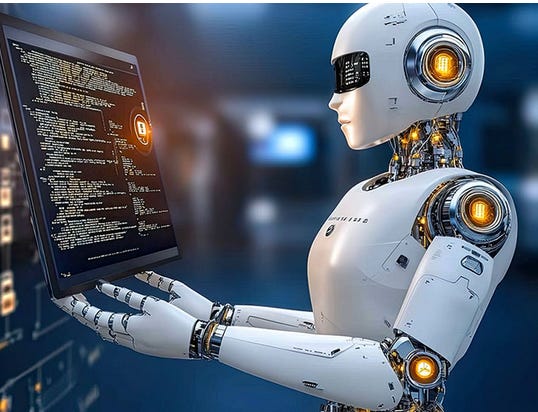
Today, tens of thousands of workers are being replaced by artificial intelligence. The vast majority of these workers are simply cast out, without any consideration of their plight.
The U.S. Equal Employment Opportunity Commission (EEOC), the primary enforcer of federal civil rights laws, states it is illegal to discriminate against a job applicant or employee because of the person’s “protected characteristic” (sex, race, etc.). Perhaps, then, being human should be a protected characteristic?
Should human workers be a new protected class?
Many workers who lose their jobs to AI are subjected to treatment by employers that might be deemed actionable if they were members of a class of workers protected by federal discrimination laws.
Reuters recently reported that Meta, which operates Facebook, has installed tracking software on U.S.-based employees’ computers to capture employee mouse movements and keystrokes for AI training data. The no-opt-out tool also takes occasional snapshots of the content on employees’ screens. Reuters wrote that the program is part of a broad initiative at Meta to build AI agents that can perform work tasks autonomously.
It is easy to jump to the conclusion that Meta is effectively making workers train their replacements. This is reminiscent of employers that require older workers to train younger replacements, which potentially violates the Age Discrimination in Employment Act of 1967.
