Roberts Calls Idea Of Partisan Judges 'Absurd'
Despite evidence to the contrary, U.S. Supreme Court Chief Justice John G. Roberts, Jr., insists it is "really fallacious" to say judges follow in the footsteps of the presidents who appointed them.
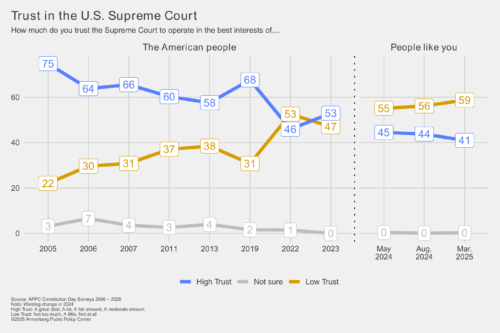
Trust in the federal judiciary has plunged in recent years as Americans have come to realize that justice is often tainted by self-interest and partisan politics.
In a talk Tuesday at Houston’s Rice University, U.S. Supreme Court Chief Justice John G. Roberts, Jr. was asked to name the leading misconceptions about the courts. He dismissed the idea that judges serve the interests of the political party or president that appointed them.
“The perspective, or notion, that we carry forward the views of people that appointed us is absurd,” he said.
He compared the Supreme Court to “a real family,” adding that the family “is not going to look kindly on the idea that you’re just carrying out someone else’s views. You’ve got eight other views to factor in now and the justices do that.”
Crisis?
Some would say the courts are in crisis — or at least facing unprecedented challenges.
Several GOP members of the U.S. Congress have called for impeaching a handful of Democratic-appointed federal judges.
There is a pending motion to impeach Washington D.C. Chief Judge James, E. Boasberg for repeatedly abusing his judicial power to thwart Republican President Donald J. Trump’s administration. Boasberg was nominated to the federal bench by Democratic President Barack Obama.
“Chuck Schumer says Biden-appointed judges will be bulwark against Trump” - Headline, The Guardian, Dec. 26, 2024
U.S. Sen. Chuck Schumer, the former Democratic majority leader, promised in 2024, when Trump began his second term in office, that outgoing Democratic President Joe Biden’s legacy would be protected by the 235 federal judges appointed during Biden’s four-years in office — more than a quarter of the federal judiciary.
So far, Schumer’s prediction seems to be on target.
On Monday, the U.S. Supreme Court rejected — for the second time — an immigration-related ruling by Massachusetts U.S. District Judge Brian E. Murphy, a Biden nominee. Yet, hours later, Murphy, a former public defender, on Monday blocked a new vaccine policy proposed by an advisory panel of doctors for the U.S. Department of Health and Human Services.
Immigration and vaccine mandates are among the Trump administration’s top agenda items.
Meanwhile, trust in the Supreme Court has plummeted 27 percentage points since 2019, falling from 68% to 41% as of March 2025, according to the Annenberg Public Policy Center. Nearly a third of Americans report having “no trust at all” in the Court to operate in the best interests of "people like you."
‘Supreme Leader’?
Roberts, who was an appellate lawyer prior to his court appointment, is technically the head of the federal judiciary.
In addition to his role as chief justice, he serves as the chair of the Judicial Conference of the United States, the policymaking body of the federal judiciary. The conference also oversees the Administrative Office of the U.S. Courts, which manages court budgets, personnel and technology.
Yet, Roberts rarely addresses the judiciary as the leader of some 200 courts and 30,000 employees. He typically limits his public comments to his role as one of the nine justices on the Court.
From the outset, federal courts have operated in a highly decentralized manner, with regional outposts that have minimal connection to one another and little to no outside accountability. The system of siloed courts largely continues today.
The Judicial Conference has recently declared its top priority is replacing the judiciary’s aging computerized case management system, which has suffered several embarrassing breaches dating back to 2020. Initial components are being tested at six courts around the country. The new system will incorporate state-of-the-art security features across all courts.
Diverse?
Roberts was nominated by President George W. Bush and confirmed by the Senate in 2005, replacing Chief Justice William Rehnquist. He was the youngest chief justice since John Marshall.
Roberts noted that five different presidents nominated the current members of the U.S. Supreme Court. “That is diverse … Well, in some places we’re not very diverse. We’re from three different law schools.” (Harvard, Yale and Notre Dame).
Roberts said history is full of examples of presidents who were “really surprised” about how Supreme Court appointees “turned out - going both ways.” He said some appointees prove more conservative and some more liberal. “The idea that they’re carrying out some different agenda is, I think, really fallacious,” he said.
Still, today few Americans are shocked when U.S. Supreme Court rulings split 6-3 along ideological lines, or when federal judges rule in line with the presidents who appointed them.
The event was held by the Baker Institute of Public Policy at Rice University.


