Mega-Donors Are Undermining The Founders' Vision Of Democracy
Why won't the U.S. Supreme Court fix its 2010 decision, Citizens United v. Federal Election Commission, which paved the way for private funding of federal elections by mega-donors and super PACs?
Thomas Jefferson said, “The true basis of a republic is the equal right of every citizen to have an equal voice in the government’s direction.”
Today, a few hundred mega-donors use super PACs that arguably control U.S. domestic and foreign policy, flooding out the voices of ordinary citizens.
The U.S. would not be bombing Iran if Israel had not exploited Citizens United’s campaign financing loophole.
The New York Times reports that billionaire spending on elections was about 0.3 percent in 2010, the year the U.S. Supreme Court decided Citizens United v. Federal Election Commission. By 2024, billionaire spending accounted for nearly 19% of all federal campaign contributions.
The U.S. Supreme Court could address the problems caused by Citizens United. It could revisit the holding, possibly in a new case that presents relevant issues. Instead, the Court fiddles while Rome burns. Members of the U.S. Congress have little incentive to address the problem, which keeps them in office, and an effort to amend the U.S. Constitution seems remote.
In the Citizens United decision, a 5-4 razor-thin majority of Republican-appointed justices held that political expenditures are a form of political speech protected by the First Amendment. The Court held that bans on independent political expenditures by corporations, unions, and associations violate the First Amendment.
Anything goes, as long as the PAC is not coordinated with or officially part of a political campaign — a distinction that is often without a difference.
After Citizens United, super PACs began to organize and raise unlimited funds — without disclosing their donors in many cases.
Casino magnate Sheldon Adelson, now deceased, and his wife, Miriam Adelson, both ardent pro-Israel advocates, reportedly donated an estimated $292 million between 2010 and 2020 to primarily Republican PACs. Miriam Adelson gave $100 million to the Preserve America PAC, a pro-Trump super PAC, in 2024.
On the other side of the aisle, Mike Bloomberg, a media titan and former Democratic mayor of New York City, spent $150 million supporting Democratic candidates in 2020, with about $563,000, deposited into Bloomberg’s super PAC, Independence USA. (Note: Bloomberg also spent a record-breaking $1.1 billion of his own money in 2020 on his short-lived run for president.)
The donations by the Adelsons and Bloomberg were not officially tied to a party, though the tie was obvious.
Private Election Funding
A recent scholarly analysis. Democracy Under Siege: The Demise of Successful U.S. Federal Campaign Finance Reform, appeared in the journal, Studies in American Political Development, published by Cambridge University Press. The authors, Purdue University Prof. Robin Stryker and Purdue PhD candidate Olivia Neff, write that “private funding” of U.S. federal elections is at “record levels, with most money contributed by a few very wealthy individuals and organizations.”
Today, the speech of individual citizens is drowned out by a small number of mega donors and billionaires.
Stryker and Neff report that the ten largest individual donors contributed over $1.2 billion in the 2024 federal election cycle, a sharp rise from $31.6 million in 2010.
They argue that campaign finance reform is stymied by, among other things, political polarization, the institutionalization of partisan niche media, and the recent near parity of Democrats and Republicans in Congress.
Delusion?
The Citizens United decision was not based on a strong record of precedents and legal research. For example, the 1907 Tillman Act prohibited national banks and business corporations from making financial contributions to national elections for any political office. It is one of many finance reform bills adopted by Congress to curb the influence of moneyed interests in federal elections, capped by the 2002 Bipartisan Campaign Finance Reform Act.
Some would argue the Citizens United decision was based on a delusion.
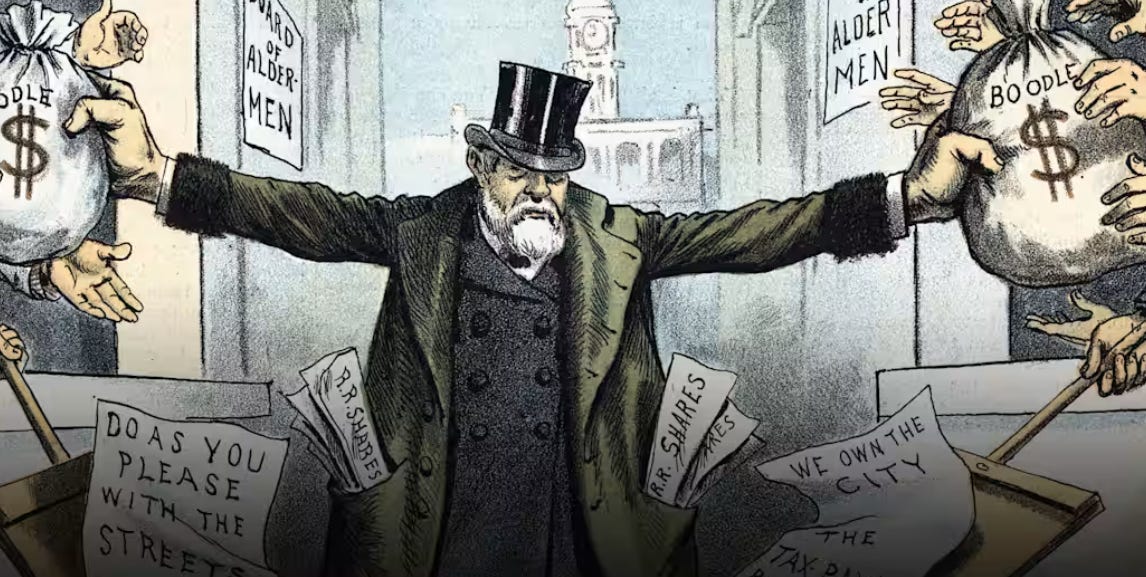
Justice Anthony Kennedy, who wrote the majority decision, said independent political expenditures by corporations and other outside groups “do not give rise to corruption or the appearance of corruption.” This seems to ignore the 19th Century Gilded Age, when robber barons used campaign financing, lobbying, and bribes to secure favorable laws and create monopolies.
Kennedy then linked free speech with education. He wrote that campaign spending is a form of “speech” that informs the public and, therefore, a ban on independent spending by corporations, unions, and other associations violates the First Amendment.
Kennedy was joined by Chief Justice John Roberts and Justices Antonin Scalia, Clarence Thomas and Samuel Alito.
Lost Faith
Americans know the U.S. system of governance is not working, and have lost faith in government and the courts.
In a 2023 survey by Pew Research Center, large majorities of Republicans and Democrats alike said campaign donors, lobbyists and special interest groups have too much influence on decisions made by Congress.
About 72% of Americans said there should be limits on campaign spending, and almost 60% thought there should be laws that reduce the role of money in politics. Eight in ten Americans said Congress members do a bad job at keeping their personal financial interests separate from their work in Congress.
Amending the U.S. Constitution
U.S. Rep. Pramila Jayapal (D-WA) last year introduced a Constitutional amendment — the We the People Amendment — to “end corporate personhood, reverse Citizens United, put power back into the hands of people, and make it clear that money does not equal speech.”
“In every election cycle since the disastrous Citizens United decision,” said Jayapal, “we have seen more and more special interest, dark money poured into campaigns across the country.”
Jayapal’s amendment has garnered about 30 Congressional supporters, all Democrats.
Amending the Constitution requires a vote of two-thirds of both the House and Senate, followed by ratification by three-fourths of state legislatures. The Constitution was last amended in 1992.
The Equal Protection Clause of the Fourteenth Amendment guarantees that the government cannot “deny to any person… the equal protection of the laws.” States invoke the Equal Protection Clause in battles over redistricting, claiming the other side is trying to thwart voters’ rights to fair representation.
But the bigger problem is that all voters are being denied fair representation in U.S. government when a small number of mega donors call the shots.


This is such a solid discussion Patricia! I’ve said it before but it deserves reiteration: your writing style is so concise and clean and boom-boom-boom hits every point. It’s a vibe. 😊