
He May Die In Prison For Writing A Book
A federal jury has convicted an 73-year-old man who wrote a book called "How to Kill a Federal Judge." He faces a 30-year prison term. No one seems to care.
“Congress shall make no law... abridging the freedom of speech, or of the press...” - First Amendment.
It is thought to be the first time in U.S. history that an author has been convicted on criminal charges for writing a book.
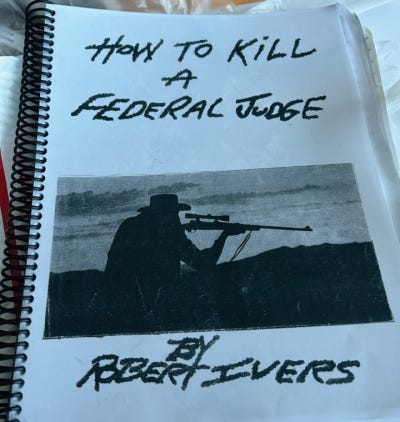
On Friday, a federal jury found Robert Phillip Ivers, 73, guilty on two counts of mailing threatening communications and threatening to murder a federal judge. The “communications” and “threat” consist of a book that Ivers provocatively entitled, “How to Kill a Federal Judge.”
Ivers now faces 30 years in prison.
No authors’ group or free press organization appears to have objected to Ivers’s indictment by a federal grand jury, and no news outlet appears to have covered his three-day trial in Minnesota.
Tattered Remnants of Free Speech
I read Ivers’s book, and it seems to me that it is well within the bounds of free speech.
The U.S. Supreme Court ruled in Brandenburg v. Ohio (1969) that speech is protected unless it is “directed to inciting or producing imminent lawless action and is likely to incite or produce such action.” Ivers’s alleged threats are far from “imminent.” His book was written in a spiral notebook over a period of years. A draft of the book was introduced as evidence in a 2022 federal case against Ivers that was dismissed.
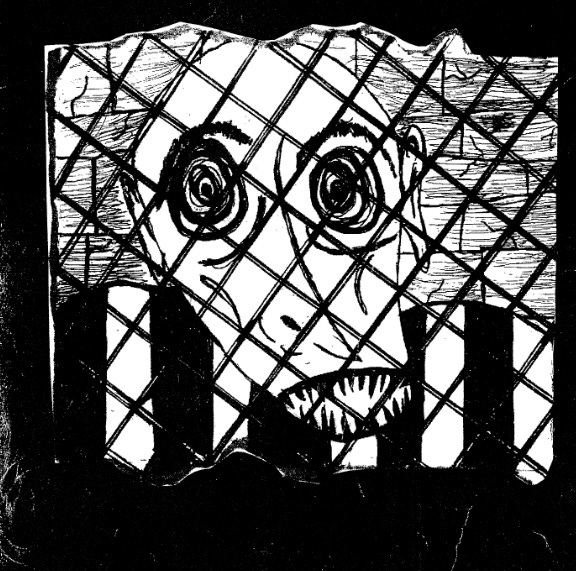
Would a reasonable person consider Ivers’s book to be a true threat? The book consists mainly of notations on court documents, hyperbole, satire, angry venting, and drawings (see above) that represent true artistic expression. No evidence shows that Ivers possessed the required mental state to actually harm anyone.
Ivers offers little in the way of how to kill federal judges. The book is mostly just over-the-top warnings.
In the past, courts recognized a distinction between a book that describes how to do something and one that constitutes a threat to do something. See The Anarchists Cookbook (1971) and Hit Man: A Technical Manual for Independent Contractors (1983). What about Bella Mackie’s fictional book, How to Kill Your Family (2021)? None of those books resulted in the criminal prosecution of the author.
Apparently these are all just pesky details to presiding U.S. District Judge Karen E. Schreier, a semi-retired judge who was nominated by Democratic President Bill Clinton.
U.S. Attorney in Minnesota Daniel N. Rosen, who was nominated by Republican President Donald Trump, issued the following statement on Friday: “Today’s outcome reaffirms the strength of our justice system in the face of intimidation. Those who seek to retaliate against witnesses or judges with threats of violence will be held fully accountable.”
Speaking of over-the-top hyperbole, Rosen described Ivers’s threats as “bone-chilling.”
“Ivers poses no threat,” said Brett D. Kelley, an attorney who formerly represented Ivers, whom he described an intelligent man who has written and illustrated at least two other self-published books.
Motivation
Ivers was brutalized by the federal court system after an insurance company in 2015 refused to pay out a $100,000 bequest on an insurance policy. Ivers’s federal lawsuit was dismissed by U.S. District Judge Wilhelmina Wright of Minnesota. Ivers, who was self-represented, apparently missed a deadline to request a jury trial. He didn’t understand the rules.

When two volunteer attorneys told him that Wright had ruled in such a way that he couldn’t refile the case, Ivers said he had been so upset that he told them that he had “imagined 50 ways to kill her.” Despite attorney/client privilege, the volunteer attorneys informed federal authorities of Ivers’s supposed “threat.”

The current proceedings began when librarians at the Wayzata Library in Minnesota became concerned that Ivers was using a printing machine to make copies of his book.
Ivers became the focus of an investigation that — according to the U.S. Attorney’s Office — including the FBI, U.S. Marshals Service, U.S. Supreme Court Police, U.S. Secret Service, Wayzata Police Department and Saint Paul Police Department.
They discovered that Ivers mailed the book — which authorities refer to as a 236-page manifesto — to a Minneapolis law firm and the University of St. Thomas.
Frenzy
The federal judiciary whipped itself into a frenzy of paranoia after the murder of Daniel Anderl, the 20-year-old son of U.S. District Judge Esther Salas of New Jersey. A disgruntled men’s rights attorney posing as a delivery man shot Anderl when he opened the door to Salas’ home in 2020.
Salas campaigned and succeeded in convincing the U.S. Congress to pass the Daniel Anderl Judicial Security and Privacy Act in 2022, which gives federal judges unprecedented “privacy” rights. Meanwhile, the U.S. Marshals Service began critics of the judiciary. Congress gave federal courts $892 million for security in 2026, a 19% increase over the prior year. In short, the judiciary has managed to secure more protection for federal judges than is granted to state and local judges, who deal with violent criminals every day.
Ultimately, the real threat in the Ivers case is the attempt by the powerful and unaccountable U.S. Court system to intimidate and silence critics.
A truly disturbing aspect of Ivers’s case is the silence of the media and free speech advocates. Where are they? Have corporations finally achieved complete control of the publishing and the media? Corporations aren’t interested in defending free speech. They’re selling stuff.
If this is the new normal, God help writers and artists.