
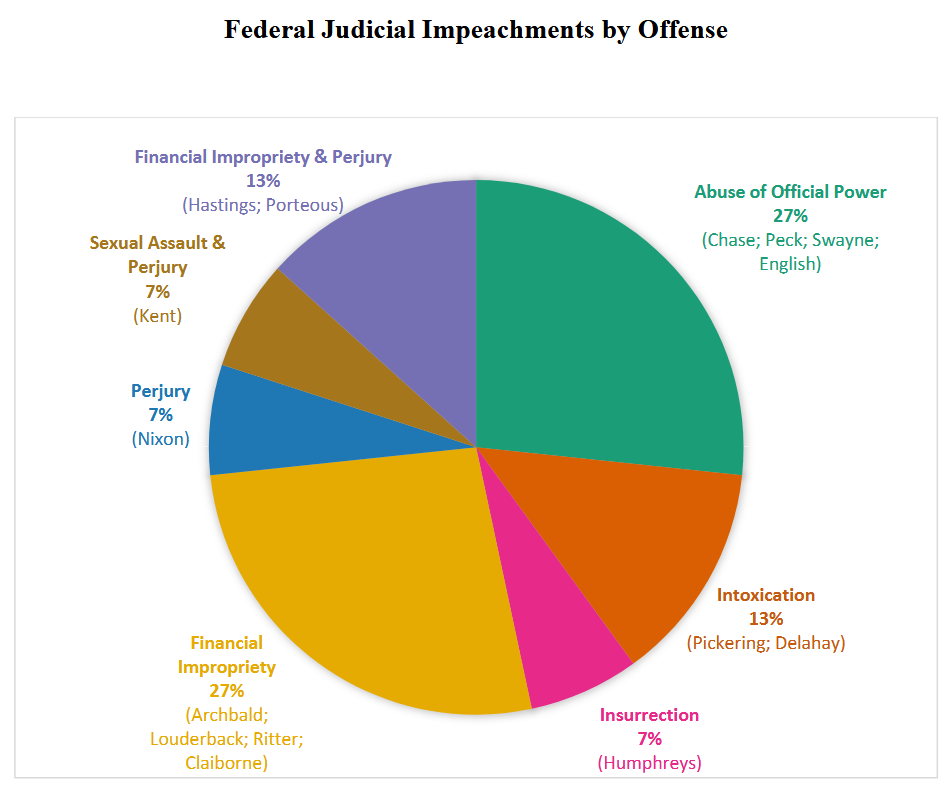
Until the 1920s, most impeachments of federal judges involved abuse of power while on the bench.
For example, the U.S. House of Representatives impeached Missouri Judge James H. Peck in 1830 for misusing his contempt of court power by jailing an attorney for one day and disbarring him for 18 months. Peck learned that the attorney, Luke Lawless, had anonymously published a newspaper article criticizing Peck’s ruling in a land dispute case. The Senate acquitted Peck by a single vote.
On Wednesday, a Senate Judiciary Committee subcommittee took a step toward holding impeachment proceedings against two federal judges —Chief U.S. District Judge James Boasberg in Washington, D.C., and U.S. District Judge Deborah Boardman in Greenbelt, Maryland.
The most serious case involves Boasberg, who approved subpoenas for the phone records of 10 GOP senators and one House member sought by former Special Counsel Jack Smith's investigation into Trump's 2020 electoral loss. Boasberg then issued a gag order preventing the phone carrier from notifying the Senators about the subpoenas.
Twenty House Republican lawmakers have signed an impeachment resolution accusing Boasberg of impropriety.
Senate Judiciary Chair Ted Cruz (R-TX) said the republic is threatened when a federal judge “aligns with a political party to investigate its opposition.” He has asked House Speaker Mike Johnson (R-LA) to move impeachment proceedings forward.
Boardman is charged with abusing her judicial power by imposing an “indefensibly light” eight-year prison sentence on a California resident who admitted attempting to assassinate U.S. Supreme Court Justice Brett Kavanaugh in 2022. Prosecutors sought a sentence of 30-years-to-life for the transgender defendant, Sophie Roske (formerly Nicholas Roske). One of Boardman’s considerations was potential difficulties Roske could face in an all-male federal prison.
Misconception
Prof. Robert Luther III of George Mason University, testifying before the Senate subcommittee, said it is a “modern misconception” that federal judges cannot be impeached for conduct on the bench. He explained that America’s founders intentionally gave the Senate broad discretion because they recognized that impeachment is a “political” (as opposed to purely partisan) tool.
To date, Luther said, seven of the eight U.S. judges who have been impeached were charged with extra-judicial conduct, such as perjury or tax evasion. However, Luther added, “This trend is not the rule.”
Luther was particularly critical of Boasberg, who has claimed he was not notified that the subpoenas and gag orders pertained to members of Congress. Luther countered that Boasberg should not have signed the gag orders without verifying their scope.
"One must ask on what basis Judge Boasberg found that the disclosure of subpoenas would result in destruction of or tampering with evidence, intimidation of potential witnesses, and cause serious jeopardy to the investigation,” said Luther.
He further questioned whether Boasberg “merely rubber-stamped the requested gag order, or was he willfully blind? Equally troubling is Judge Boasberg’s failure to enter a show cause order against Smith for withholding your identities.’"
Luther noted that Congress passed a law in 2020 imposing an affirmative obligation on telecom service providers to notify members of Congress when their records are subpoenaed. He said Smith and Boasberg “inexplicably” ignored the law and “chilled” GOP legislator’s ability to conduct business “in violation of the Speech or Debate Clause of the U.S. Constitution.”
Luther said Boasburg demonstrated “contempt for the separation of powers” as it was envisioned by America’s founders.
“The cloak of judicial independence does not shroud a judge from accountability — before this body or the public … Judge Boasberg must be held accountable,” said Luther.
Trump called last year for Boasberg's impeachment, prompting Chief U.S. Supreme Court Justice John Roberts to respond that impeachment as "not an appropriate response to disagreement concerning a judicial decision."
Lack of Accountability
The federal judiciary lacks an independent review process for judicial misconduct complaints, resulting in a serious lack of accountability within the system. There is overwhelming evidence that corruption in the federal judiciary is tolerated and overlooked.
Almost all misconduct complaints are routinely dismissed without investigation by chief circuit judges, who have built-in vested interests, such as friendships with judges and the desire to minimize the appearance of scandal in their bailiwick. This judiciary ignored a 2022 report by the Government Accountability Office that said its policies for addressing alleged fraud, waste, and abuse don't align with investigative best practices.
The refusal of the third branch of government to address misconduct on the bench leaves lawmakers with little choice but to consider drastic remedies like impeachment.