
Fat And Lazy: The Free Speech Industry
A well-financed free speech organization turned its back on an author federally prosecuted after writing a book, "How to Kill a Federal Judge".
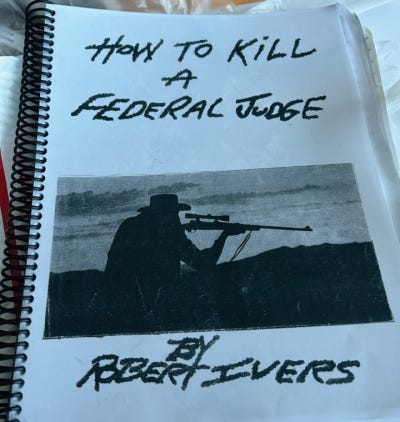
Can you be an “author” if you don’t have an agent or a publishing contract?
Is it a “book” that is entitled to protection under the First Amendment when it is handwritten, unpublished, or self-published? If it sold online or from the trunk of a car. If it has not sold a single copy?
The answers all may be yes, but they are irrelevant if authors lack the resources to defend their Constitutional rights.
Not a single free speech organization objected recently when an author was put on trial and convicted for the crime of writing a book that provoked the ire of one of the most powerful groups in the country, the fat-cat federal judiciary. As a result, Robert Ivers, a 73-year-old old man with heart trouble, may spend the rest of his life in a federal prison.
The irony is that this is happening at a time when the free speech industry is thriving like never before!
FIRE
Take the case of the Foundation for Individual Rights and Expression (FIRE), a 501(c)(3) tax-exempt charity based in Philadelphia, PA.
FIRE was called The Foundation for Individual Rights in Education until 2022 when it announced a $75 million expansion into off-campus free speech advocacy and defense. The rebranded organization, The Foundation for Individual Rights and Expression, is now the leading organization in the U.S. that is solely dedicated to defending free speech.
“America needs a new nonpartisan defender of free speech that will advocate unapologetically for this fundamental human right in both the court of law and the court of public opinion,” said FIRE President & CEO Greg Lukianoff in 2022.
The money started pouring in.
FIRE’s assets have jumped about 48% since its rebranding, from about $50 million in 2022 to $74 million in 2025. Fidelity Investments Charitable Gift Fund has donated almost $15 million to FIRE since 2022, and Vanguard Charitable donated more than $10 million. FIRE’s revenues in 2025 totaled $40 million, while expenses were less than $30 million.
These are especially good times for FIRE’s senior staff.
Lukianoff’s base compensation rate jumped from $407,221 in 2022 to $621,657 in 2025, which is a 52.7% increase. Two other FIRE officers earned more than $400,000 in 2025, another earned $368,000, and three earned almost $300,000. FIRE has about 120 employees.
Earlier this week, I asked FIRE’s media office a series of questions but got no response. These unanswered questions include:
How can FIRE justify its extremely well-financed existence when it ignores the fact that an author has - possibly for the first time in U.S. history - been convicted of a crime for writing a book and is likely to die in prison as a result?
Does FIRE not consider Ivers to be an author because he doesn't have an agent and his book wasn't published by Simon & Schuster? Who is an author?
Of course, FIRE isn’t alone. Many other organizations have ignored Ivers, including The American Civil Liberties Union, PEN and The Author’s Guild.
CASELAW
There is a legal case to be made for Ivers under the First Amendment.
The U.S. Supreme Court in 1969 overturned the criminal conviction of a Ku Klux Klan leader, Clarence Brandenburg, who, while speaking at a rally, made threats of “revengeance” if the President, Congress and Supreme Court continued to “suppress” the white race. The Court ruled that inflammatory speech - even speech advocating violence or lawbreaking - is protected by the First Amendment “except where such advocacy is directed to inciting or producing imminent lawless action and is likely to incite or produce such action."
The Court in Watts v. United States (1969) distinguished between a genuine threat of violence and “political hyperbole” or exaggerated and metaphorical speech.
Yes, Ivers’s book is highly inflammatory, but it consists of exaggerated hyperbole. Where is the imminent threat? The book was in the works for at least five years. It was introduced as evidence in a 2022 case that was dismissed. Where is the evidence that Ivers intended to commit an act of unlawful violence?
The book appears to pose no actual threat to any federal judge.
Ivers compares his work to shouting “kill the umpire” at a baseball game.
It all may boil down to class.
Ivers is not a particularly appealing guy. He once lived in his car. He has no money, which is how this matter began. A federal court judge dismissed his lawsuit in 2015 to require an insurance company to pay him a $100,000 bequest. Let’s just say, Ivers doesn’t vacation in Nantucket with members of The Author’s Guild
The Ivers case raises a serious question about what is free speech today when federal judges - who are supposed to safeguard and protect the First Amendment - jail the author of a book that offends them and no one seems to care?
Since the early days of the United States, it was understood that a person who wrote a political tract or pamphlet was an author by virtue of having composed it, regardless of whether a commercial publishing company printed or distributed it.
It was universally agreed that the First Amendment existed to protect noxious and unpopular speech, even threats.
"If there is a bedrock principle underlying the First Amendment, it is that the government may not prohibit the expression of an idea simply because society finds the idea itself offensive or disagreeable." - U.S. Supreme Court, Texas v. Johnson (1989).
What a quaint idea.