
Bottom Line: Korean Spas Where Girls And Women Are Nude Must Admit Men
Ninth Circuit court uses smoke and mirrors to uphold a panel's 2-1 ruling requiring Washington state's traditional women-only spas to admit men who say they "identify" as women.
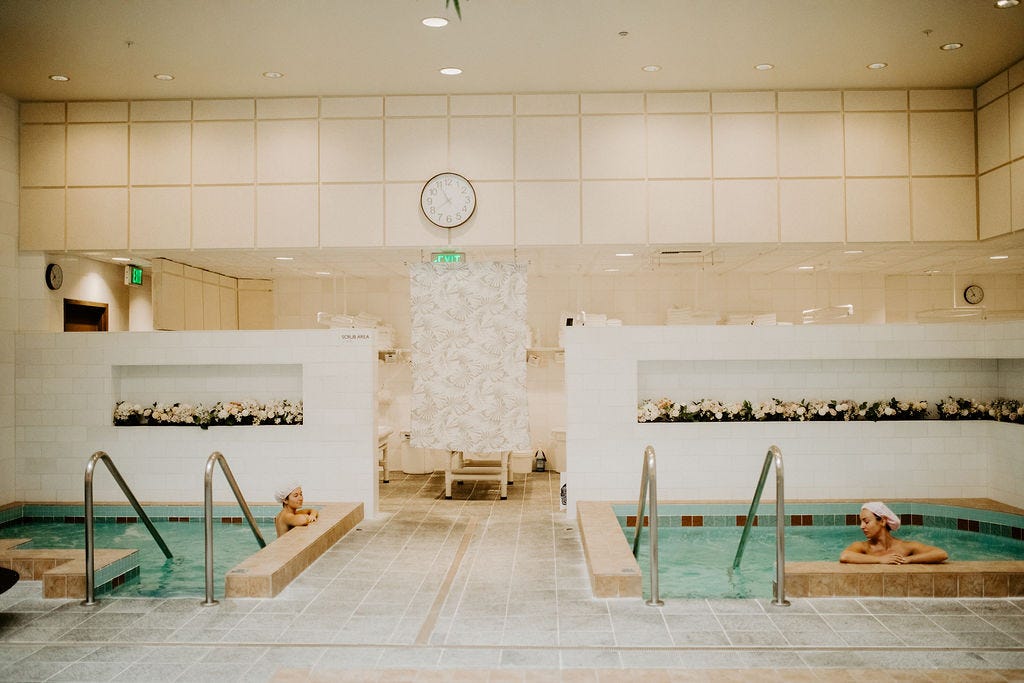
It’s an epic misstep so, predictably, the U.S. Court of Appeals for the Ninth Circuit in San Francisco is doubling down.
A three-judge panel of the Ninth Circuit ruled 2-1 in May that traditional Korean spas in Washington that feature communal baths for girls and women — who are nude — must admit men who say they “identify” as women but did not undergo gender confirmation surgery to remove their male genitalia.
This week, the appeals court announced that it would not require the panel to rehear the case, and vetoed a request for an “en banc” hearing by all the active judges of the Ninth Circuit.
So the ruling - arguably the “most clueless” of 2025 - stands.
Not only must preoperative “trans women” (a.k.a., intact men) be admitted to traditional all-female Korean baths, but female spa attendants must give them the same service as if they were women, including deep tissue massages, even if it makes them feel “uncomfortable.”
Smoke and Mirrors
In a written order, Senior Judge M. Margaret McKeown attempts to characterize the Ninth Circuit as powerless to do the right thing because the plaintiffs didn’t argue the case a different way.
At the same time, McKeown, 74, and Judge Ronald M. Gould, 79, who remains an active judge, the two panel members who ordered the spas to admit fully intact men, voted to deny the appellant’s petition for a rehearing by the panel, so the parties could address the relevant legal issues. Both McKeown and Gould are nominees of former Democratic President Bill Clinton.
McKeown, complains the plaintiffs failed to attack the constitutionality of the state law in Washington that prohibits public facilities from discriminating on the basis of gender identity.
Instead, she said, the plaintiffs sued state officials on First Amendment grounds, claiming the way they enforced the law violated the spa’s First Amendment rights to freedom of speech, religion and association.
It might seem to be a difference without a distinction, but McKeown insists it is not. “The Spa simply did not challenge the statute itself, and it is not our role to rewrite the statute,” she writes.
McKeown argues, in effect, that the court has no choice but to require enforcement of Washington law that potentially (obviously?) violates the U.S. Constitution.
It’s all smoke and mirrors, of course.
If the plaintiff’s attorneys didn’t address the relevant legal issues in their complaint, the lower court judge / panel simply could have directed them to do so. Often this is done by dismissing the original complaint with the expectation that a new complaint will be filed. Or the panel could have simply raised the issue, and ordered the parties to respond to and brief its concerns.
Moreover, the full circuit court could have considered the case “en banc” - with all the active judges on the circuit weighing in. McKeown writes that a judge requested a hearing by the full circuit, but it failed to receive a “a majority of votes of the nonrecused active judges.” McKeown cast a “no” vote.
Ultimately, the case turned on McKeown and Gould’s apparent belief that men who say the magic words — that they identify as women — are entitled to the full legal rights of women, including entry to a female-only spa. Everything else is verbiage.
The majority split mostly along partisan lines, with Democratic nominated judges supporting McKeown and Gould.
Dissents
Judge Kenneth K. Lee, a Korean American who dissented from the original panel decision, writes, in dissent of the panel’s refusal to reconsider the matter, that Korean spas are steeped in centuries old tradition and require patrons to be fully naked in communal saunas and undergo deep-tissue scrubbing of their entire bodies.
“Now, under edict from the state, women — and even girls as young as 13 years old — must be nude alongside patrons with exposed male genitalia as they receive treatment. And female spa employees must provide full-body massages to naked pre-operative transgender women with intact male sexual organs,” writes Lee, who was nominated by GOP President Donald J. Trump.
He argued the Washington law does not include transgender status as a protected class, adding, “transgender status is different from sexual orientation.” He said the spa allows lesbians and bisexuals who are biologically female.
Wild Man
Another dissent was filed by the “wild card” of the federal judiciary, Lawrence Van Dyke, a Trump nominee.
“This is a case about swinging dicks,” writes Van Dyke. “The Christian owners of Olympus Spa — a traditional Korean, women-only, nude spa — understandably don’t want them in their spa.”
He continued: “Woke regulators and complicit judges seem entirely willing, even eager, to ignore the consequences that their Frankenstein social experiments impose on real women and young girls.”
Van Dyke writes that the complainant in the case is Haven Wilvich, “a man who identified as female, has twice been married to women, and remains sexually attracted to women.” Wilvich never actually visited the spa but “called ahead of a friend’s visit.”
Van Dyke writes that the Washington law redefines “sex” in a manner that “undermines the legal protections granted to women as a class and generates an irreconcilable conflict with criminal laws against voyeurism and indecent exposure. We should have reheard this case en banc and reversed this perversion.”
(As they say, even a stopped clock is right twice a day.)
Van Dyke’s observations provoked condemnation from the majority, including Judges Danielle J. Forrest (also nominated by Trump) and John B. Owens (nominated by former Democratic President Barack Obama), who wrote “We are better than this.”
A phalanx of mostly Democratic judges, led by Chief Judge Mary Murguia, objected to Van Dykes tone, stating that federal courts are “not a place for vulgar barroom talk.” They blamed Van Dyke for demeaning the court (apparently oblivious to their role).
(But Murguia does not think it’s vulgar to allow a strange nude man to sit in a pool beside a nude 13-year-old girl, or to force a reluctant female spa employee to give him a deep tissue massage. This is the Ninth Circuit, full frontal.)
The case is Olympus Spa v. Armstrong, No. 23-4031 (9th Cir., Mar 12, 2026).
In Addition to Gould and McKeown, the majority dissent included Clinton nominees Senior Judges Michael Daly Hawkins, William A. Fletcher and Richard A. Paez. Also joining the dissent was Anna Isabel de Alba, who was nominated by former Democratic President Joseph Biden, and Milan D. Smith, Jr., an independent who was nominated by GOP President George W. Bush.